Showing posts with label Romance Art. Show all posts

Saturday, May 16, 2015

Tom Hall, Cover Artist Extraordinaire (1932-2010)


You may not know the name but you will recognize his art. Tom Hall is an icon when it comes to romance novel cover art. His art has graced covers long treasured by readers of historical romance.

Hall became famous during the 1970s with 200 book covers to his credit, including such books as The Thorn Birds, Shanna and Ashes in the Wind, which sold multiple millions. New York art directors called him the “leading paperback artist in the country” and “a giant in the industry.” So he was and so he remains.

In 1981, Bantam Books art director Don Munson told the Associated Press that Hall "is a remarkably fine artist. His attention to realistic detail reminds me of the Hudson River Valley painters and his evocative style recalls the French impressionists."


Now that resonated with me because my very favorite painters come from the Hudson River School of painting, a 19th century American art movement whose landscape painters were influenced by romanticism. (My very favorite of those is Albert Bierstadt, painter of the American West.) You can see the style in Tom Hall’s work.

While producing paperback art, Hall did illustrations for Reader's Digest and National Geographic publications and for several Discovery Channel documentaries.

In his later years, he focused more on painting for pleasure. His subjects included Chester County landscapes and American Indian and historical subjects. He also continued to paint his "lovely ladies."

Hall's paintings are included in the collections of the National Museum of American Illustration, the Coast Guard, the National Geographic Society, the Delaware Art Museum, and many private collectors. His work was exhibited in shows in Japan, New York City, Salt Lake City, and Tucson, Arizona as well as in local galleries. I love his covers and savor each paperback I have that displays his wonderful art. The emotion leaps off the page, the details providing readers with hours of pleasure.

Here are some of his covers. You'll see many on my best lists and on my Top 20 List.


Monday, June 2, 2014

Albert Bierstadt (1830-1902) – Painter of the American West


Albert Bierstadt was among the most internationally honored American artists of the nineteenth century. Born in Solingen, Germany, he emigrated at age two to America with his parents and his two brothers. The family settled in New Bedford, Massachusetts, where his father became established as a barrel maker. He studied (1853-57) painting in Dusseldorf, Germany, and Rome and traveled extensively on the Continent. Although he had entered that period of formal training with only rudimentary capabilities, he emerged from it an ambitious, technically proficient master whose tastes for European scenery and society had been considerably enhanced in the process.

In 1858, he joined the expedition of Colonel F. W. Landers to survey an overland wagon route to the Far West. This trip to the west including the territories of Colorado and Wyoming was to procure sketches for a series of large-scale landscape paintings of the American West. Back in New York, he painted a sequence of canvases that secured his reputation as a "western" artist. He made two additional western journeys, one in 1863, the other from 1871 to 1873.

The Rocky Mountains


Bierstadt was part of the Hudson River School, a group of like-minded painters whose style involved carefully detailed paintings with romantic, almost glowing lighting, sometimes called luminism.

Bierstadt painted the West as one who loves its beauty. His paintings evoke romantic images and stir feelings in us even if we have lived our lives in the American West.


As you read the western historical romances I've reviewed and those on my "best list" I post every June, picture the west as Bierstadt saw it: A place of great majestic open spaces and colors more beautiful than any many could create on his own.

Yosemite Valley

The Last of the Buffalo

The Oregon Trail

Friday, May 23, 2014

My Favorite Classic Historical Romance Novel Covers!


I know some of you miss the old covers because you've told me as much. They had so much emotion in them. And they gave us a real sense of the hero and heroine. Amazingly, many featured heroes wearing clothes!

I thought it would be fun to share some of my favorites from my best lists. And you must tell me yours!

[Click on the title below the cover to see the book on Amazon]

A Gentle Feuding
Beloved Rogue
Bitterleaf
Bride of the MacHugh
Capture the Sun
Comanche Heart
Fire and Steel
Glynda
Golden Lady
Lady Vixen
Love Unwilling
Master of Desire
Midnight Masquerade
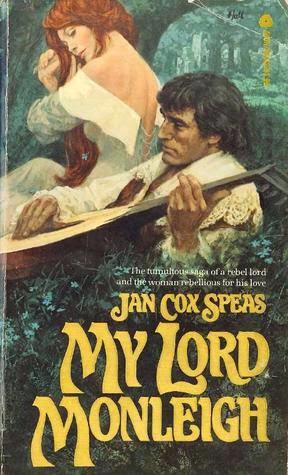
My Lord Monleigh
My Love, My Enemy
Passion's Ransom
Pirate in my Arms
Rose in Splendor
Silver Storm
Star of the West
Surrender in Moonlight
The Black Lyon
The Black Swan
The Dragon and the Jewel
The Falcon and the Flower
The Pirate and the Pagan
The Silver Devil
The Taming
The Border Lord
Dark Before the Rising Sun
Wild Bells to the Wild Sky
Irish Linen

Saturday, October 5, 2013

The Beautiful Art of Edmund Blair Leighton (1852-1922)


Since it’s Medieval Romance month on my blog, it seemed only fitting that I should tell you more about Edmund Blair Leighton, a gifted Victorian artist who gave us such beautiful renderings of medieval love to the world.

To this day, very little has been published about Blair Leighton. There are no modern monographs dedicated to his work, and he is seldom mentioned in books, which discuss Victorian art, and yet his paintings are among the most recognizable of Victorian art and have garnered large prices at auction. His works of Godspeed (1900) and The Accolade (1901)--pictured below--can be seen in almost every poster shop around the world and are used as the epitome of medieval iconography.

If one looks at the visual elements in Godspeed, for example, it is clear that that very few paintings so well capture the essence of this subgenre of historical romance.


The beautiful maiden on the steps of a stone castle, the knight in shining armor, the white steed, and the sense of immediate peril, which threatens the subjects’ contentment almost define our modern day conception of Medieval legend and romantic sentiment.


The Accolade derived its inspiration from a French work on chivalry, which mentioned that even ladies occasionally conferred the order of knighthood on worthy men.

You could say Leighton inherited his gift from his father, Charles Blair Leighton, who was a very talented artist, and exhibited several works during his short career (he died when he was only thirty-two years of age.)

Though Blair Leighton was forced by his family into a mercantile career, the artistic impulse in his heart refused to be denied. He spent all of his spare time in drawing, and made such progress that when he was seventeen he decided to devote his evenings after business hours to the study of art. When he turned twenty-one, he announced to his family that, cost what it might, he would be a painter. To that end he had been saving all he could out of his salary, and managed to put by enough to provide a good year’s start. He resolved first to get into the Royal Academy Schools. So, he went to the British Museum, did the necessary drawings as examples of his skill, and was soon admitted as a student.

To meet his expenses, he began to sell his illustrations, which drew comparatively high prices. The reason for his rapid success was perhaps to be found in the fact that he treated each drawing as if it were a picture, not only paying models to sit for him, but even going to the expense of hiring the right costumes. About eighteen months after he had entered the Royal Academy Schools, he sent his first picture to the Royal Academy Exhibition. The critic of the Standard at that time (1877) expressed the hope that the artist would not be demoralized by being elected a Member of the Academy too soon, but would be kept waiting for a time till he had done some more good work.

In 1885, he married Katherine Nash, with whom he had two children, Eric James Blair Leighton, who also attended the Royal Academy School of Art, and Sophie Blair Leighton, who married the famous British civil engineer Sir Harold John Boyer Harding.

Although Blair Leighton was elected to the Royal Institute of Oil Painters in 1887, he was never voted in as an associate of the Royal Academy. His career hit its peak in and around 1900 with his most famous works of Godspeed being in 1900, The Accolade, 1901, The End of the Song (pictured on left), 1902, Alian Chartier, 1903, and Vox Populi, 1904. He continued to paint other great masterpieces for many years, with less and less large-scale works as he neared the end of his life.

He died on September 1st 1922, but we can still enjoy his legacy of beautiful, romantic paintings.


Sources:

The Art of Mr. E. Blair Leighton by Rudolph De Cordova
E. Blair Leighton: The Prominent Outsider by Kara Ross
Edmund Blair Leighton, English Pre-Raphaelite (2nd Wave) Painter